Why 810 nm keeps appearing in tPBM conversations
When B2B buyers compare PBM helmet suppliers, wavelength is often the first specification they ask about. In transcranial photobiomodulation research, 810 nm is one of the most familiar near-infrared wavelengths because it has been used across human cognitive studies, pilot trials, and mechanism-oriented animal work. A 2023 systematic review of human tPBM studies reported that 810 nm was among the common near-infrared protocol choices in clinical populations, while also noting that the literature includes other red and near-infrared wavelengths.
That matters for OEM buyers because it gives 810 nm a recognizable research language. It does not mean every 810 nm helmet is clinically equivalent. Output power, irradiance, fluence, duty cycle, optical contact, LED layout, scalp coverage, treatment time, and protocol design all change the product story.
Penetration is not a slogan; it is a design question
A head-tissue penetration review found that reported visible-to-near-infrared transcranial light penetration varies widely across species and human studies. The variation is linked to wavelength, coherence, tissue thickness, anatomical location, beam size, and irradiation parameters.
For a private-label PBM helmet project, this is exactly why buyers should ask for more than a wavelength number. They should review LED distribution, channel map, output-control logic, testing workflow, and the way the supplier documents optical and electrical parameters. In a B2B sales conversation, careful documentation is more persuasive than broad therapeutic claims.
810 nm and mitochondrial research context
Many PBM papers discuss cytochrome c oxidase, a mitochondrial enzyme involved in cellular oxygen use and ATP production. One 810 nm transcranial laser study in young and aged rat brains mapped regional cytochrome c oxidase activity after chronic PBM exposure. This kind of work is useful for explaining why PBM is discussed in the language of mitochondrial bioenergetics and brain function.
For public marketing, the responsible framing is simple: mechanism research helps explain why the field is scientifically active, but it is not product-specific proof for a commercial helmet. OEM brands still need market-specific claims review, compliance documentation, and product-level validation.
Why frequency control is becoming part of the premium product story
Recent PBM research is also paying more attention to pulsed light and frequency. A 2026 animal study applied pulsed 810 nm PBM at theta- and gamma-related frequencies and examined cognitive and brain-network markers. A separate 2026 pilot randomized study in mild cognitive impairment used pulsed 810 nm home tPBM as part of a repeated-session protocol.
This does not tell a buyer which commercial preset to use. It does show why research-facing customers increasingly ask whether a helmet can support adjustable frequency, documented session logic, and repeatable protocol settings.
How this connects to the suyzeko 21-channel PBM helmet platform
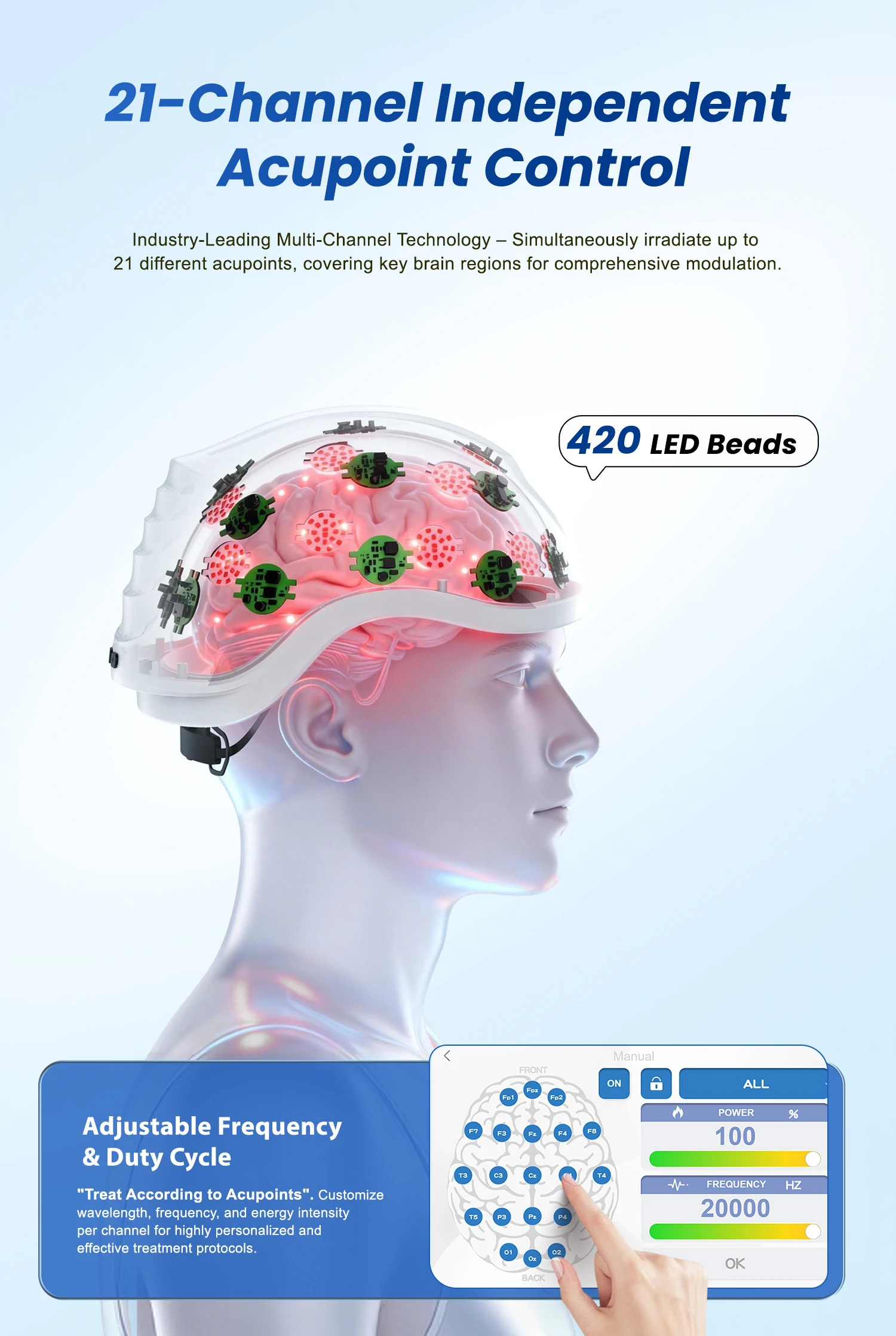
The suyzeko 21-channel PBM helmet platform is designed for partners who want a premium OEM story around control architecture, wavelength configuration, and protocol differentiation. The current platform includes 21 independent channels, 420 LED beads, 810+1070 nm dual wavelengths, 1-20000 Hz frequency adjustment, 1-100% power adjustment, app control, and OEM-ready branding options.
The important B2B value is not to say that the helmet recreates any specific clinical study. The value is that a partner can build a more serious product program: channel-level naming, protocol interface design, private-label packaging, test documentation, and a research-aware education library. For distributors, clinics, and research suppliers, that can be the difference between a generic catalog item and a product platform with a credible launch story.
What OEM buyers should ask before launching an 810 nm PBM helmet
- Which wavelength configuration will be public: 810 nm only, 1070 nm only, or a dual-wavelength 810+1070 nm platform?
- How are LEDs distributed across the scalp, and can the channel or zone map be shown in partner materials?
- What frequency, duty-cycle, time, and power settings are adjustable, locked, or customized by project?
- Which inspection, optical, electrical, and aging-test records can support the product file?
- Which claims are allowed in the target market, and which statements must remain research-context only?
- Can the manual, app wording, packaging, and sales kit keep product claims consistent with compliance review?
Bottom line for B2B partners
810 nm gives PBM helmet buyers a recognizable research anchor. A 21-channel dual-wavelength platform gives OEM partners a stronger hardware and documentation story. The best launch combines both: research-aware education, conservative claims, and a product architecture that can be explained clearly to distributors, clinicians, and internal compliance teams.