What a Brain PBM page tells you about the market
Pages like Brain Infinity's brain photobiomodulation page do a good job of telling a reassuring story. They make the experience feel guided, speak in QEEG terms, and frame the helmet as something that can be used at home with support. That is a useful signal for OEM buyers because it shows what the audience wants first: clarity, confidence, and a simple path to use.
For a private-label supplier, that same audience does not stop at the story. Once buyers are ready to source a product, they start asking how the story maps to hardware choices, user controls, packaging, and the evidence file behind the product.
Where the buying questions change
A consumer-facing PBM page can lead with language about guidance, convenience, and brain wellness. An OEM partner has to translate that into specifications. The questions become more concrete: how many channels are controlled, how are LEDs distributed, what frequencies are adjustable, what can the app or controller say, and what documents can support a launch in a serious market.
| Buyer question | Brain PBM page signal | 21-channel OEM answer |
|---|---|---|
| What is the product story? | A guided brain-PBM narrative that feels approachable for parents, clinics, and home users. | A private-label product story that can be repeated by distributors, clinics, and sales teams without drift. |
| How is control explained? | A 4-quadrant or targeted-use message that keeps the interface easy to understand. | 21 independent channels with room for channel naming, preset logic, and differentiated protocol design. |
| What wavelength story is visible? | A strong 1070 nm emphasis in the public narrative. | A dual-wavelength 810+1070 nm platform that gives OEM buyers more positioning flexibility. |
| What proof does the buyer want? | Research references, guidance language, and clear use-case framing. | LED layout, frequency range, power adjustment, QA records, manuals, packaging, and compliance wording. |
| Who is the real customer? | Parents, home users, and guided brain-wellness clients. | Distributors, clinics, and research-facing brands that need a premium product platform. |
Why 21 channels matter in an OEM conversation
A 4-quadrant story is easy to explain, but a 21-channel platform is easier to differentiate. It gives a private-label brand more room to define presets, explain scalp coverage, and build a product ladder around the same hardware family. That is valuable when the market already has plenty of generic-looking helmets.
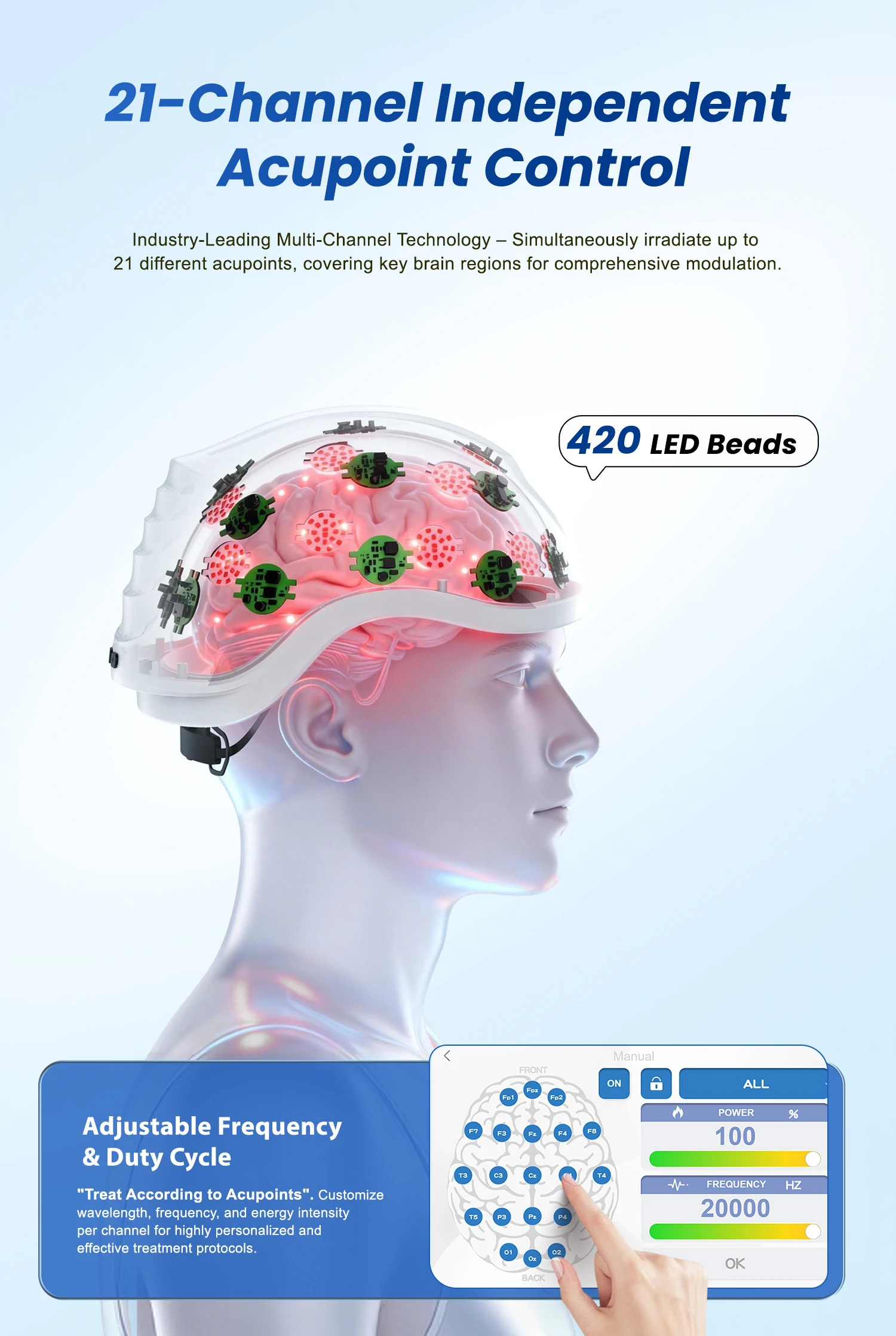
Our 21-channel PBM helmet is built for that kind of buyer. The platform includes 21 independent channels, 420 LED beads, 810+1070 nm dual wavelengths, 1-20000 Hz frequency adjustment, 1-100% power adjustment, app control, and OEM-ready branding options.
What similar customers usually care about
- A clear brain-PBM narrative that can be explained without technical confusion
- A control architecture that supports premium positioning instead of commodity pricing
- A wavelength story that fits both research context and commercial packaging
- A product file that includes QA, manuals, and partner-facing wording
- A launch package that helps distributors and clinics sell with confidence
Bottom line
If a Brain Infinity-style page wins attention through education and guided use, a 21-channel OEM platform converts that attention into a product story a partner can own, brand, and scale.