Why this review matters to OEM buyers
The 2024 review by Fernandes and colleagues is useful because it focuses on the devices themselves, not just the hoped-for outcomes. The authors screened 2,133 records and included 97 studies on brain photobiomodulation. Their message is plain: the field is active, but reporting is still uneven, and that makes it hard to compare devices with confidence.
For a supplier, that is not a problem to hide. It is an opportunity to do better. A serious OEM buyer wants a helmet platform that can explain device design, actuation site, output logic, and documentation in a clean, repeatable way.
What the review extracted from the literature
The paper did not just count studies. It looked at the device design, actuation area, actuation site, wavelength, mode of operation, power density, energy density, power output, energy per session, and treatment time. Those are the exact details a B2B buyer should request from a manufacturer before committing to a private-label launch.
That kind of reporting discipline matters because brain-PBM products are easy to oversimplify. A brochure can say the right wavelength, but without control architecture, test data, and clear parameter reporting, the buyer is left guessing how the product is actually built.
What the missing detail tells us
One of the most striking findings in the review is that 28% of devices were not described clearly enough to fit neatly into the authors' categories. That is a signal to OEM buyers that product communication still has room to improve across the market.
In practice, better communication means more than marketing copy. It means clearly defined LED layout, actuation site, channel or zone logic, frequency settings, power range, and inspection records that a distributor or clinic brand can understand.
How the suyzeko 21-channel helmet fits this conversation
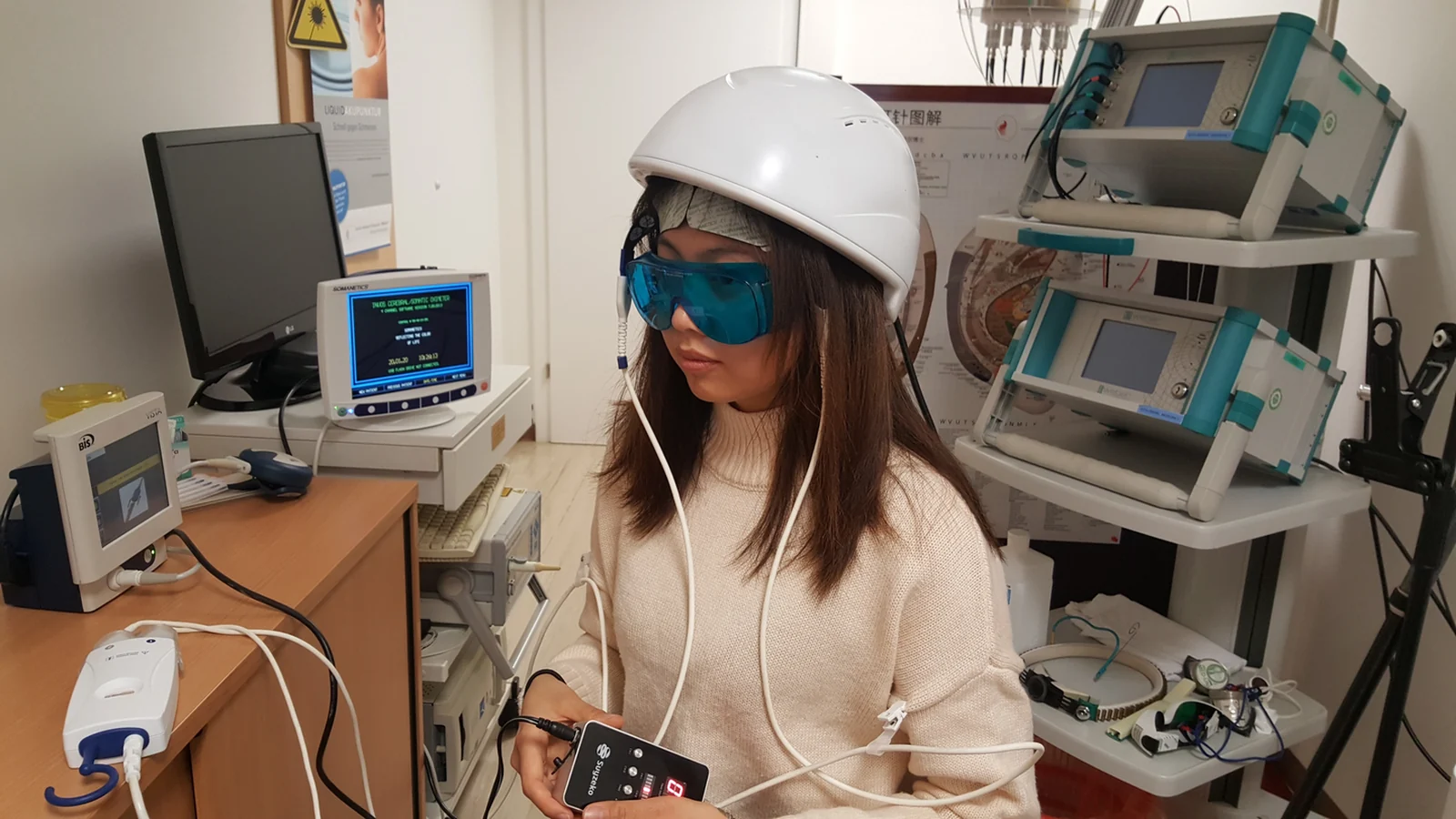
The suyzeko 21-channel PBM helmet is built for exactly this kind of buyer expectation. It offers 21 independent channels, 420 LED beads, 810+1070 nm dual wavelengths, 1-20000 Hz frequency adjustment, 1-100% power adjustment, app control, and OEM-ready branding options.
That does not mean it reproduces any paper's outcomes. It means the hardware story is more complete. A private-label partner can define channel naming, protocol structure, packaging, manuals, and QA documentation in a way that feels professional rather than vague.
What this means for your B2B launch
If your market is asking for a PBM helmet, your sales team should be able to answer more than one question: what wavelength, what control architecture, what proof, and what documentation. The 2024 review makes it clear that the market still needs standardization, so suppliers that can provide a cleaner device narrative will stand out faster.
Bottom line
The value of this paper is not a new medical claim. It is a reminder that device reporting quality is part of product quality. For OEM buyers, the strongest PBM helmet partners are the ones that can define the hardware clearly, document it cleanly, and keep the public wording conservative.